

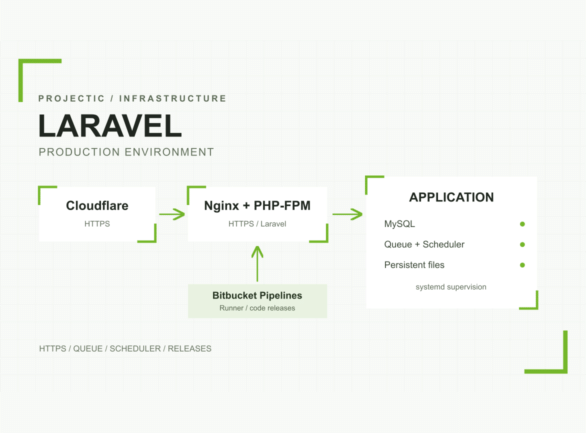
A seasonal online campaign has a fixed launch date. Alongside a working application, it needs an environment that supports its database, uploaded files, background jobs and future releases. We prepared a production server for a Laravel application built for such a campaign.
This project covers infrastructure and application deployment. The system’s business features are a separate scope of work.
The challenge: prepare the complete application environment
Launching Laravel involves more than making the homepage load. The application uses a database and stores files, while some tasks run outside the user’s web request. The environment therefore also needed a queue worker and a recurring task scheduler.
Another requirement was an orderly update process. Each new code release needed to use the correct configuration and retain existing data. We also prepared a separate test environment so application checks did not have to begin on the public version.
What did we deliver?
We configured a Linux environment with Nginx, PHP 8.4-FPM and MySQL. Nginx handles web traffic, PHP-FPM executes the application code, and MySQL stores the system’s data. We enabled HTTPS on the origin server operating behind Cloudflare.
We placed the Laravel queue worker and scheduler under systemd supervision. The scheduler runs every minute, while the queue worker operates as a separate service. During verification, the web server, PHP, database, queue worker and timer were active, and the scheduler’s latest invocation had completed successfully.
We separated code releases from persistent application files and environment configuration. Switching to another release therefore does not replace user uploads with a fresh directory from the repository. This distinction matters when preparing an environment for repeated updates, rather than a single code upload.
Repeatable deployments from Bitbucket
We prepared an automated deployment process triggered by updates to the repository’s main branch. It uses Bitbucket Pipelines and a runner operating in the server environment. Changes pass through separate branches and pull request reviews.
The process also provides a manual deployment retry and a return to the previous code release. That rollback does not reverse database migrations. Compatibility between database changes and an earlier application release therefore needs to be considered when planning each deployment.
We prepared operational documentation covering services, release deployment, code rollback and diagnostic locations. It helps identify which part of the environment to inspect when a problem involves the website, a background task or an update.
What did the traffic observation show?
After launch, we analysed the available origin server logs. On 19 October 2026, up to 14:17:28 Polish local time, we recorded 11,677 HTTP 2xx/3xx responses to requests arriving from Cloudflare networks. There were 2,849 such responses during the complete 09:00-09:59 hour and 282 during the 09:50 minute.
We found no HTTP 5xx responses in the available origin log for that day. This is an observation of that log, not a maximum-capacity test or proof of availability across the entire service. It does not include, for example, failures occurring only at the Cloudflare edge.
These figures count requests, not people, sessions or concurrent users. They include pages, images, scripts and other resources, as well as possible automated traffic. Requests served entirely from Cloudflare cache may never reach the origin server.
The outcome and scope of responsibility
The application received a running production environment, active queue processing and scheduling, and a process for publishing subsequent code releases. Verification covered service status, release configuration and observation of actual traffic.
Server configuration, application development and ongoing support are separate scopes of work. This project description does not imply round-the-clock monitoring or a guaranteed response time. Maintenance and incident support arrangements are agreed separately.
Preparing an application for launch or bringing an existing server into order? Explore our Linux server administration services. We can agree on a scope that fits your application, deadlines and maintenance needs.