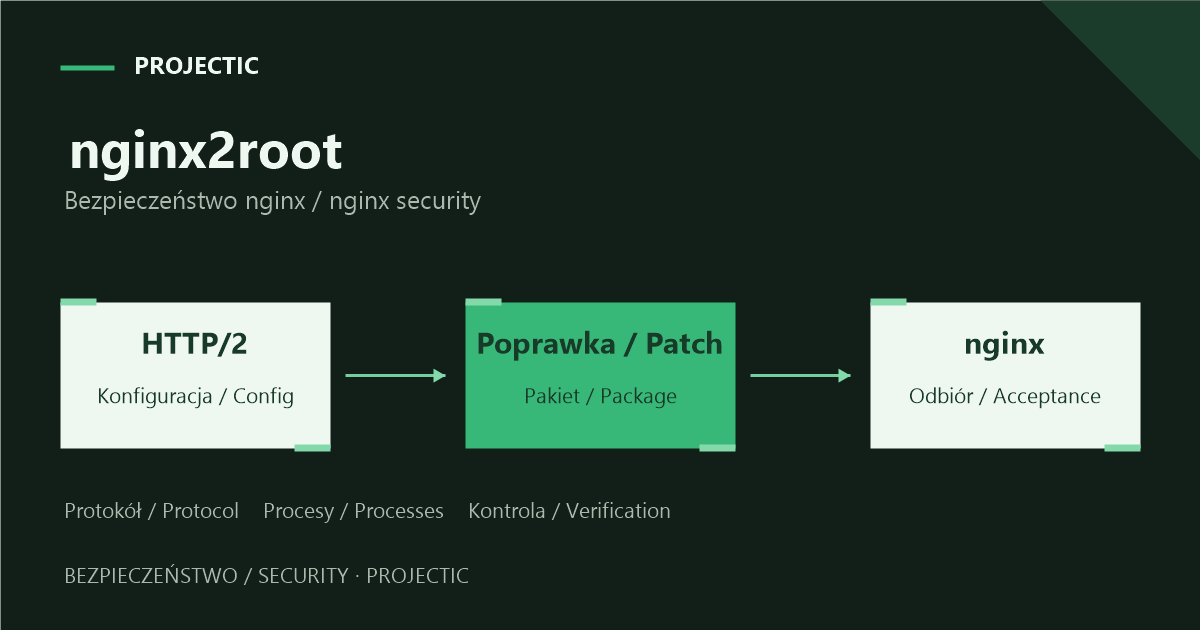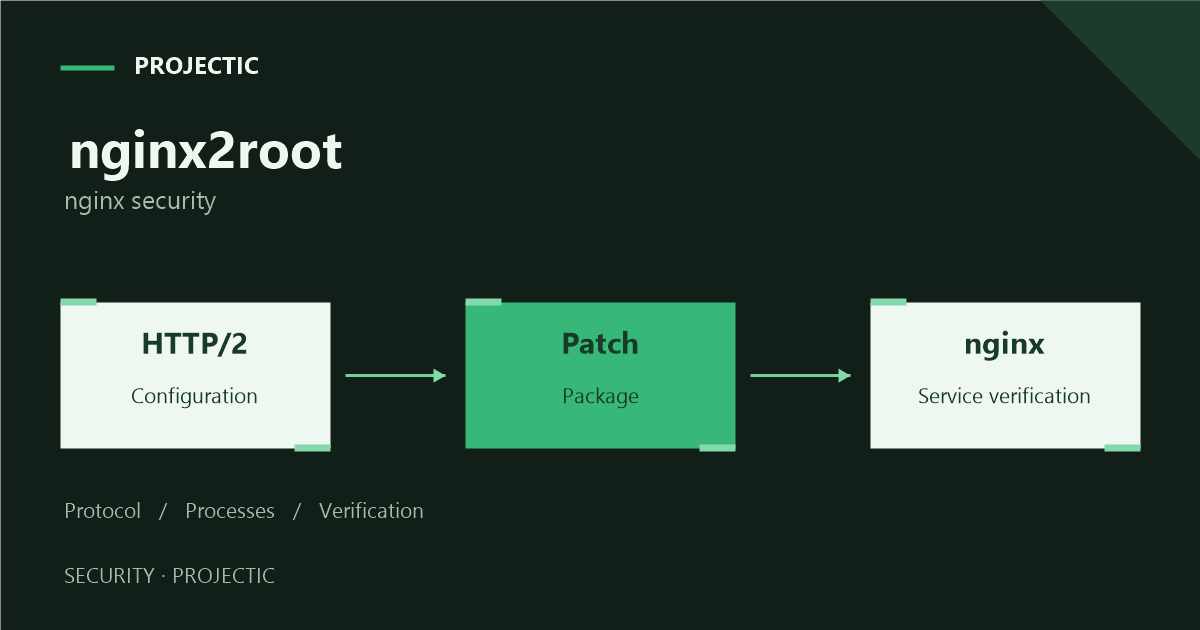
nginx2root warrants a prompt nginx assessment, especially for internet-facing HTTP/2 services. Check both the package version and the effective configuration. The presence of nginx alone does not establish which exploitation conditions apply.
Sources checked on 19 November 2026. Distribution package availability and supplier guidance can change.
Which vulnerabilities are involved?
CVE-2026-123007 affects HTTP/2 flow-control memory handling. CVE-2026-123633 is a use-after-free issue involving HTTP/2 and upstream connections. Under applicable conditions, exploitation can execute code with nginx worker privileges. CERT-EU describes the conditions.
The nginx2root name is not evidence that every installation automatically yields root access. Process privileges, configuration and any additional attack stages need separate assessment. Other relevant flaws are CVE-2026-121810 in HTTP/3, CVE-2026-123634 in the DNS resolver and CVE-2026-113425 in the mail proxy. One HTTP/2 change must not be reported as a complete fix for all of them.
Upstream releases and distribution packages
The official nginx security list identifies upstream 1.30.7+ and 1.31.9+ as fixed for these two HTTP/2 CVEs. Their affected version ranges differ.
For a packaged installation, check the full package revision and the distributor’s notice. A backport may fix a flaw without changing the base number advertised in an HTTP header. Conversely, installing a package without replacing the relevant running processes does not establish completion.
What does disabling HTTP/2 achieve?
CERT-EU lists disabling HTTP/2 as a mitigation for CVE-2026-123007 and CVE-2026-123633 when patching is not immediately possible. This limits those attack paths. It does not repair the package or provide a common fix for HTTP/3, DNS resolver and mail-module issues.
Review active configuration files, plan how existing connections will close and test the result. A CDN or reverse proxy does not replace checking the origin server’s protocol and exposure. Do not weaken other protections to simplify verification.
How should you verify the change?
- Record the running version, complete package revision and relevant modules.
- Inspect the effective configuration, including included files and HTTP/2 listeners.
- Preserve configuration and prepare a rollback for a failed change.
- Validate syntax before the required reload or restart.
- Test TLS, the website, upstream forwarding and important application functions.
- Confirm the running processes use the intended build; for a temporary restriction, also check actual protocol negotiation.
74 million web properties with potentially affected versions
In its 18 November 2026 advisory, Censys reports 74,183,698 web properties with versions in the affected ranges, compared with 331,242,037 identified nginx web properties. That is approximately 22.4% of this dataset. A web property is a hostname and port, not a unique server. A remotely identified version does not confirm the required configuration or rule out a backport. These figures describe potential exposure, not successful compromises.
Does a worker crash prove compromise?
No. Worker crashes have multiple possible causes. Incident assessment requires correlation with other evidence of process activity. A successful HTTP response after restarting also does not establish system integrity. Report exposure, temporary mitigation, permanent patching and functional acceptance as separate findings.
Support with nginx maintenance
Our Linux server administration service can help establish update scope, dependencies and service acceptance. Where the server runs a shop, pair infrastructure verification with application checks, including PrestaShop support when appropriate.