

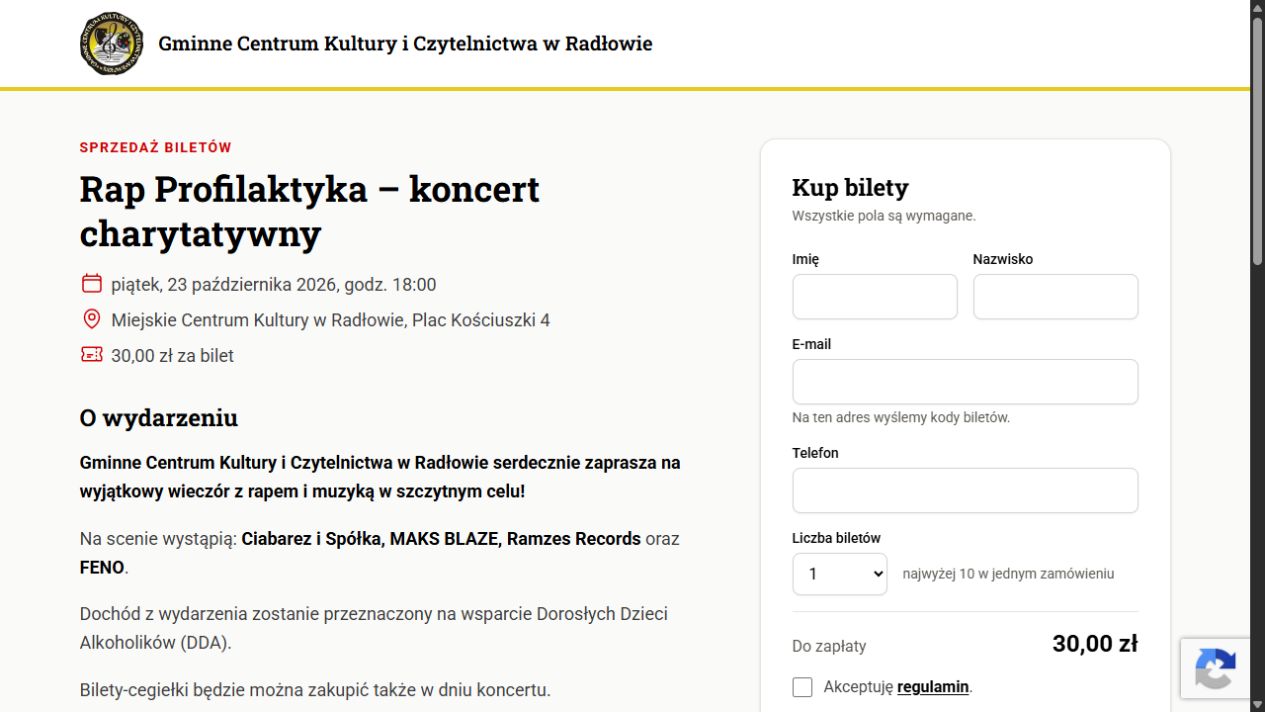
The Municipal Centre of Culture and Reading in Radłów needed a simple system for selling concert tickets. Following difficulties with an earlier delivery, the organiser approached Projectic. We had four days to implement the application. We agreed a scope covering the complete journey from the purchase form to the codes needed to collect tickets.
What had to work before ticket sales could open?
The event had a set date, a limited capacity and one type of ticket. The system needed its own web address so the organiser could link to it from their website and social media. Buyers did not need an account: they selected the number of tickets, entered their contact details, accepted the terms and proceeded to payment.
The organiser needed a clear view of orders, payment statuses and ticket codes. With a short delivery window, we focused on a defined scope for a single event that could be completed before sales opened.
How does buying a ticket work?
- Event details and a purchase form. The page presents the concert name, date, venue, price and collection instructions. The form collects the details needed to handle the order.
- Choosing the ticket quantity. In this implementation, one order can include up to 10 tickets. The available choice also reflects the remaining capacity.
- Przelewy24 payment. After placing an order, the buyer proceeds to the payment provider. The application retains the order and its current status.
- An individual code for every ticket. Once payment is confirmed, the system generates the codes and emails them to the buyer. Buying several tickets produces a separate collection code for each one.
The form uses reCAPTCHA protection. The terms are available as a PDF, and collection instructions appear both on the website and in the email containing the codes.
Why is redirecting a buyer to payment only part of the process?
Clicking the purchase button and returning from the payment website are separate stages. A paid status must come from transaction verification. The Przelewy24 integration checks the notification and confirms that the amount and currency match the order before issuing ticket codes.
We also accounted for a buyer returning before the provider’s notification arrives: the application can check the payment status at that point. A repeated notification for an already paid transaction does not generate another set of tickets.
When an order is placed, the system checks availability and temporarily reserves the required places for payment. Abandoned orders stop holding capacity after the reservation window expires. This logic sits behind the simple form and matters when the number of available places is limited.
What can the organiser manage in the panel?
We built the application with Laravel and a Filament administration panel. The organiser can view orders, ticket quantities, payment statuses and associated codes. Orders can be searched and filtered by payment status.
Event settings cover the name, date, venue, description, images, terms document and collection instructions. The organiser can also change the price, total ticket allocation, per-order limit and whether sales are enabled. These details are managed through the panel.
Can the application be reused for another event?
Yes. We designed it for reuse with one event at a time. Moving to the next event involves deliberately closing the previous edition, retaining the necessary records and technically preparing a new set of data and access credentials. We documented that procedure as part of the handover.
This model matched the client’s requirement: a simple application with its own sales page and a process tailored to a specific concert.
What did the four-day delivery achieve?
The organiser received a working purchase page, payment integration, emails with ticket codes and a panel for managing orders and event content. The key outcome was a complete process delivered within the agreed window. This case study describes the application we delivered; it does not publish sales or attendance figures.
For the delivered features, see our Laravel concert ticketing application portfolio.
Do you need an application for your own process?
We build custom Laravel applications and integrations around an organisation’s workflow. For a short delivery window, the initial brief should identify the essential features, payment provider, available content and responsibilities after launch.
Tell us about your project and deadline so we can establish a realistic scope. If you already have an application that needs a new team or further development, explore our technical support.