

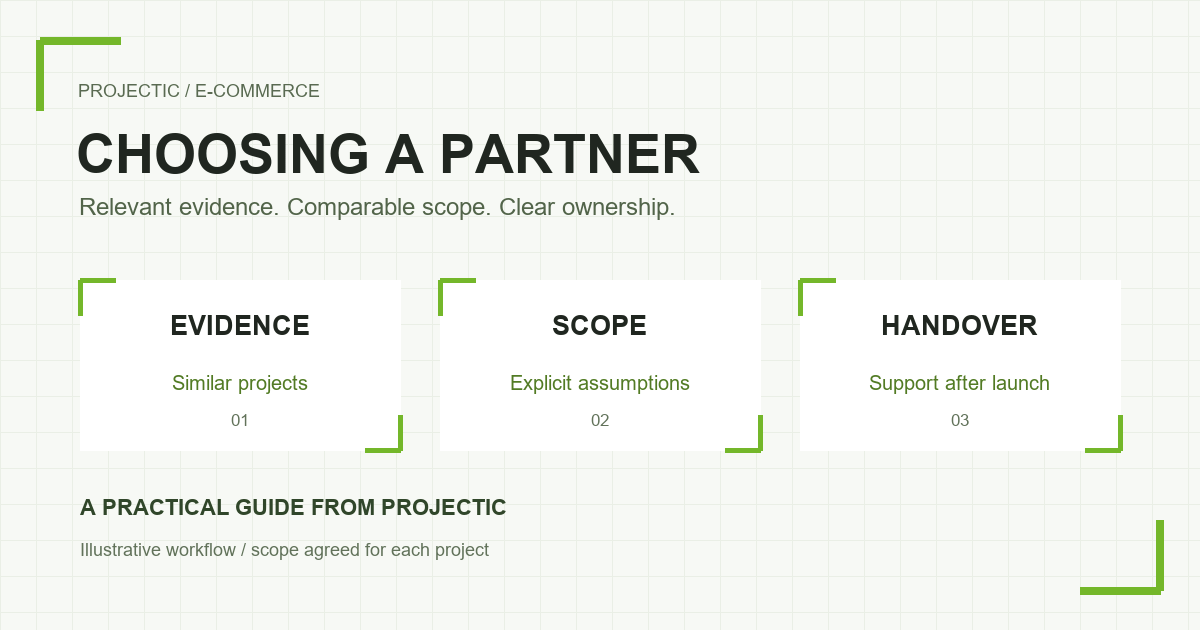
Choose an e-commerce development company by looking at relevant delivered work, how it understands your business and its plan for launch and ongoing support. An attractive portfolio and a single headline price will not tell you whether the store will work with your inventory system, payments and operations team. A useful proposal makes it clear what will be delivered, how you will accept it and who will look after it afterwards.
There is no single best agency for every online store. A small catalogue without integrations calls for different experience from a business with several warehouses, B2B price lists and an ERP. Use the questions below to compare providers on a common basis before committing to a project.
What should you prepare before asking for a quote?
Start with a short description of how you sell. You do not need to write a technical specification yourself. Explain who buys, what you sell, who handles orders and which tasks currently require manual work. A capable provider should turn that information into useful questions and a proposed scope.
- Catalogue: approximate product count, variants, bundles, customer-group pricing and the source of descriptions and photographs.
- Sales: markets, languages, currencies, retail or B2B, payment methods and delivery options.
- Operations: inventory, ERP, invoicing, marketplaces and existing integrations.
- People: responsibility for product data, prices, customer service and project acceptance.
- Constraints: a deadline tied to a real event, availability of materials and the order of essential features.
If you already run a store, describe what is wrong with the current solution. An awkward content editor does not necessarily justify migrating the whole system. Establish whether you need a new build, targeted modernisation or a support takeover. Each starts with a different investigation.
Which portfolio evidence actually matters?
Ask for work involving similar processes, not only a similar industry. A store selling different products may still be a useful example if it has comparable inventory, order handling or pricing rules. For each example, ask what the provider actually did: design, implementation, integration, a single module or later maintenance.
The description should separate delivered functionality from future plans. A major brand logo does not establish whether the team built the store or contributed a small part for another agency. A clear account of the team’s involvement is more helpful than names without context. Where a numerical result cannot be substantiated, assess the delivered capability rather than a claimed increase in sales.
One example in our portfolio is a PrestaShop implementation connected to enova365, covering product and inventory synchronisation followed by ongoing development. A separate PrestaShop and WAPRO integration built in Laravel covers catalogue, order, status and document flows. These are different scopes of work, rather than interchangeable proof of every kind of e-commerce project.
Who should choose the store platform?
Choose technology after understanding the requirements. If a provider always proposes the same platform, ask why it fits your particular workflow. The names PrestaShop, WooCommerce or a custom-built system do not establish the quality of an implementation.
Ask which requirements the standard platform handles, which need paid extensions and which require custom code. Establish who supplies and maintains those additions. ERP connections deserve particular attention: the existence of a ready-made connector does not prove compatibility with your version, configuration and operating process.
Also ask to see everyday administration: editing a product and its variants, handling an order and updating content. Your team should be able to assess those tasks before accepting the system it will operate. If a provider has no verified example of connecting WooCommerce to your ERP, request a separate feasibility assessment rather than relying on a general assurance.
What makes two proposals comparable?
Two proposals for a “complete store” may include very different work. One may cover original design and data migration; another may assume a standard theme and a catalogue supplied by the client. Request a breakdown using the same areas:
- requirements discovery and the first release’s agreed features;
- design or adaptation, including mobile layouts;
- catalogue, payment, delivery and notification configuration;
- data import or migration from a defined source;
- integrations, including the data exchanged and its direction;
- testing, corrections, launch and staff handover;
- post-launch support and ongoing third-party costs.
Include assumptions and exclusions alongside the scope. Who enters the products? Are translations ready? How many design review rounds are included? What happens when a new requirement appears? Those answers make prices easier to compare without treating the lowest number as the whole decision.
Separate implementation costs from the cost of operating the store. Domains, hosting, extension licences, maintenance and development belong in that operating plan. A proposal should identify recurring charges and responsibility for renewals. This is more useful than one universal store price applied to businesses with different requirements.
How can you tell whether an ERP integration is properly scoped?
“Integration with the warehouse” is too broad. Ask the provider to walk through an example order and product update. You should understand where price and availability come from, where the order originates, when it reaches the ERP and how staff learn that a step has failed.
- Which identifiers connect products and variants across systems?
- Which system owns prices, stock and descriptions?
- In which direction do statuses travel so an older value does not overwrite a newer one?
- How are retries, unavailable systems and incomplete imports handled?
- Who can see a failure and establish which data was actually transferred?
You do not need to audit the code yourself. You need an agreed behaviour that can be checked later. Our PrestaShop, WAPRO and Laravel integration case study illustrates why collecting an order and passing it to the ERP are distinct stages. Your own project should describe its important flows just as clearly.
What should acceptance and a controlled launch cover?
Acceptance should test agreed user scenarios, rather than only approve the home page’s appearance. Establish who writes the scenarios, where testing takes place and who accepts the business outcome. A useful checklist follows a purchase through notifications, administration and connected systems.
Before substantial changes, agree on a backup and a way to return to the previous state. PrestaShop’s documentation identifies both store files and the database as backup components. Ask about both and whether restoration has been checked. A successful backup message alone is not a complete launch plan. Source: PrestaShop backup documentation.
For an existing store, include the old-to-new URL map, redirects, order data and the point at which integrations switch over. The launch plan should identify the decision-maker and what happens if a critical scenario fails. Our guide to testing online store changes before deployment provides a practical starting point for these checks.
Who is responsible after the store goes live?
Distinguish correcting a mismatch with the agreed scope, routine maintenance and commissioning new functionality. These are different kinds of work. Ask where to submit requests, how incidents are prioritised and when an initial response is expected. Response time is different from the time required to resolve every possible fault.
At Projectic, support packages distinguish maintenance from hours used for changes and development. One-off prepaid hours valid for a year are also available. When comparing offers, check the scope, additional work and unused-hour rules. Do not assume that a subscription includes an unlimited redesign.
Agree how documentation, code, accounts and licences will be handed over, along with the team’s access arrangements. The business should know who controls its domain, hosting and payment-provider accounts. Continuing with another team should not start with discovering which accounts are needed to run the store.
Should you choose a local agency or work remotely?
Location matters when you need on-site workshops, a close look at warehouse processes or in-person training. It does not replace experience with similar systems. For remote cooperation, an agreed communication routine, short demonstrations and written decisions are particularly useful.
Projectic has an office in Kraków, Poland. Meetings are arranged in advance, and project discussions can also take place remotely. If you are evaluating a provider for a business in Warsaw or another city, compare the same evidence and delivery process. An address in a particular city does not establish the quality of the work.
How should you decide after speaking to providers?
Compare the answers in one table: relevant work and the team’s own contribution, understanding of your operations, integration scope, acceptance process, post-launch responsibility and handover. Mark each area as confirmed, to be agreed or outside the proposal. Do not simply add up scores without considering which requirements are essential to your business.
A short discovery stage can be a sensible next step if it has a defined output: first-release scope, dependencies and decisions still needed. For a new store, see our website and online store development service. For an existing system that needs repairs or a new support team, start with PrestaShop technical support.
Frequently asked questions
How do I identify the best company for my store?
Look for verified experience with comparable processes, a clear explanation of the provider’s contribution and an acceptance plan. A generic ranking cannot account for your integrations, staff or sales model. Ask each shortlisted company the same questions.
Should I choose PrestaShop or WooCommerce before finding a provider?
Start with requirements and existing systems. The provider should explain its proposed platform, extensions and operating costs. A PrestaShop implementation alone does not demonstrate experience with a particular WooCommerce integration.
Does the developer have to maintain the store afterwards?
No, but agree how future support will work before launch. Define responsibilities, documentation, required account access and handover arrangements. A later change of provider should not require reconstructing basic project information.